Businesses today operate in an environment where speed, efficiency, and adaptability are critical for success. However, many organizations still depend on manual workflows, repetitive tasks, and disconnected systems that slow down operations and increase operational costs.
Traditional automation solutions have helped streamline specific processes, but Generative AI introduces a new level of intelligence that enables businesses to automate complex workflows, improve decision-making, and enhance employee productivity. From customer support and content generation to document processing and workflow optimization, Generative AI is transforming how organizations manage their day-to-day operations. By combining machine learning, natural language processing, and large language models, businesses can automate processes that previously required significant human involvement
What Is Business Process Automation?
At its core, business process automation is about reducing the time employees spend on repetitive activities by introducing intelligent systems that can execute routine workflows more efficiently and reliably.
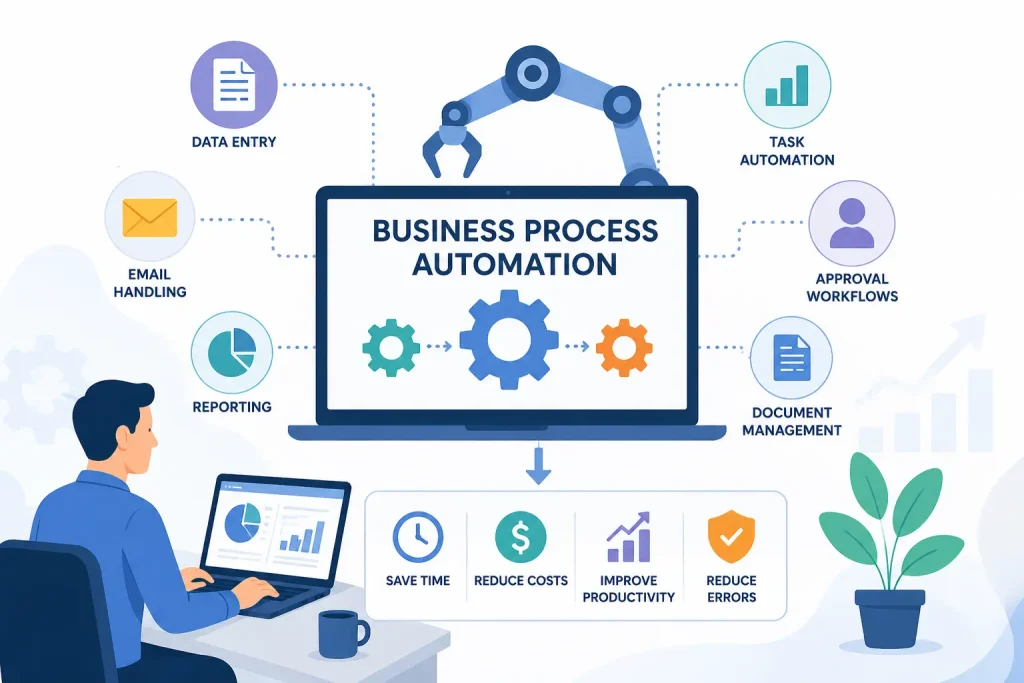
The primary objectives of automation include:
- Reducing manual work
- Improving operational efficiency
- Minimizing errors
- Accelerating decision-making
- Increasing employee productivity
- Lowering operational costs
Earlier automation technologies are designed around established business rules, allowing systems to execute tasks only within clearly defined conditions.
While effective for repetitive tasks, they often struggle with unstructured data, natural language interactions, and dynamic business requirements.
Generative AI addresses these limitations by introducing intelligent automation capabilities that can understand, create, and respond to information in a more human-like manner.
How Generative AI Differs from Traditional Automation
Traditional automation tools typically operate based on fixed rules and predefined conditions.
- If a customer submits a form, the system generates a ticket.
- If inventory reaches a certain threshold, a purchase order is created.
- If an invoice is approved, the payment process begins.
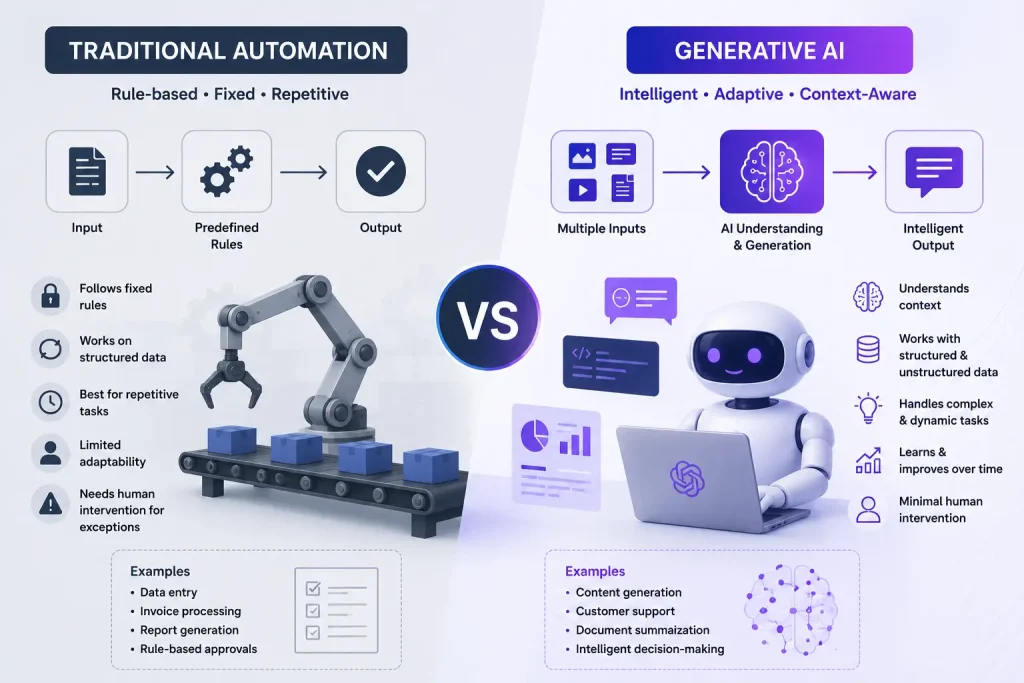
Generative AI goes beyond rule-based execution by understanding context, generating content, summarizing information, and interacting through natural language.
It can:
- Draft business documents
- Summarize meetings
- Generate reports
- Answer customer queries
- Analyze large datasets
- Recommend business actions
- Support intelligent decision-making
This enables organizations to automate more sophisticated business processes without building complex rule engines for every scenario.
Customer Support Automation
Customer service is one of the most common applications of Generative AI in business environments.
AI-powered assistants and conversational agents can:
- Answer frequently asked questions
- Handle support tickets
- Provide product recommendations
- Assist customers in real time
- Escalate complex issues to human representatives
Unlike traditional chatbots, Generative AI systems understand context and generate more natural responses, improving customer experiences while reducing support workloads.
Organizations can provide 24/7 assistance without significantly increasing operational costs.
Intelligent Document Processing
Businesses generate large volumes of documents every day, including:
- Contracts
- Invoices
- Purchase orders
- Reports
- Emails
- Meeting notes
Generative AI helps automate document-intensive workflows by:
- Extracting critical information
- Summarizing lengthy documents
- Generating reports
- Classifying business records
- Creating actionable insights
This reduces manual processing time and enables employees to focus on higher-value activities.
Workflow Automation Across Departments
Generative AI supports automation across multiple business functions.
Human Resources
HR teams can automate:
- Employee onboarding processes
- Policy document generation
- Candidate screening
- Internal knowledge assistance
- Training material creation
Sales and Marketing
Sales departments benefit from:
- Automated proposal generation
- Lead qualification
- Personalized email creation
- Customer insights
- Marketing content development
Finance and Accounting
Finance teams can use AI for:
- Invoice processing
- Financial report summaries
- Budget analysis
- Expense categorization
- Compliance documentation
Operations and Procurement
Operational workflows become more efficient through:
- Vendor communication automation
- Procurement document generation
- Inventory analysis
- Demand forecasting
- Workflow optimization
This cross-functional approach helps organizations create connected and intelligent business environments.
The Role of AI Agents in Business Automation
AI agents introduce a more intelligent approach to automation by coordinating tasks, interacting with business applications, and assisting employees throughout entire workflows rather than handling isolated activities.
- Understand business objectives
- Execute multiple actions
- Interact with enterprise applications
- Collaborate with employees
- Continuously learn from interactions
For example, an AI procurement agent might:
- Analyze inventory levels
- Generate purchase recommendations
- Draft supplier communications
- Track order status
- Provide management summaries
These capabilities enable businesses to automate complete workflows rather than individual tasks.
Benefits of Generative AI for Business Process Automation
Organizations adopting Generative AI solutions often experience several advantages.
Increased Productivity
Employees spend less time on repetitive activities and more time on strategic initiatives.
Faster Decision-Making
AI-generated insights and summaries help management teams make informed decisions more quickly.
Reduced Operational Costs
Automation decreases manual workloads and improves resource utilization.
Improved Customer Experiences
AI-powered interactions enable faster and more personalized customer support.
Better Scalability
Businesses can handle growing workloads without proportionally increasing operational resources.
These benefits contribute to improved efficiency and long-term business growth.
Challenges Businesses Should Consider
Although Generative AI offers significant opportunities, organizations must address certain challenges during implementation.
Data Security
Sensitive business information requires proper governance and security controls.
Integration Requirements
AI solutions must work seamlessly with existing business systems and workflows.
Employee Adoption
Successful implementation depends on user training and change management strategies.
Ethical Considerations
Businesses should establish clear guidelines for responsible AI usage and decision-making.
Addressing these factors helps maximize the value of AI-driven automation initiatives.
The Future of Intelligent Business Operations
Generative AI is changing how organizations approach process automation.
Instead of relying solely on predefined workflows, businesses can build intelligent systems that understand information, generate content, support decision-making, and continuously improve operational efficiency.
As AI technologies evolve, organizations will increasingly adopt AI agents, copilots, and intelligent assistants to automate complex business activities across departments.
Companies that embrace these technologies today position themselves for greater agility, innovation, and competitiveness in the future.
Conclusion
Generative AI is redefining business process automation by combining traditional workflow optimization with advanced language understanding and intelligent decision-making capabilities.
From customer support and document management to sales, HR, and procurement, organizations can automate complex processes while improving efficiency and reducing operational costs.
Businesses that successfully integrate Generative AI into their operations gain more than automation they create intelligent systems that support growth, enhance productivity, and enable better business outcomes in an increasingly digital world.